

Candles, again.
On humanity's most sacred and consequential tool.

Shloshim (שלושים): the 30-day Jewish mourning period.
The shloshim for the victims of the Hanukkah Massacre at Bondi now ends. For the first and last time, I ask only that you read this aloud.
Language doesn’t just describe reality; it creates it.
Like no other people, Jews have experienced the power of language across millennia to spread light in history’s darkest chapters, and its power to darken the corners of every century.
Today, we must confront how a very particular type of language paved the way for the Bondi Hanukkah massacre. It is a type of language distinct from the anti-Jewish language we label ‘antisemitic’. What makes it distinct is that, while it produces the same harms as antisemitism, it does so via a new permission structure that replaces race-based libels for state-based libels.
This language and the violence it wreaks go unchallenged by the strategies and frameworks in place to protect Australians from vilification unless it crosses the line into race-based bigotry. A category error gives bigotry and conspiracy licence to tear at the fabric of Jewish Australia on one condition: that it make no overt mention of Jews as a race or religion.
It is the language of the antizionist that has made much of the West unsafe for the Jewish people. Pursuing antisemites has failed to quell the vilification because antisemites are not its primary driver.
It is the language of antizionism, not antisemitism, whose promised global intifada is to blame for the murder of 15 at Bondi.
Two years in two hours.
In the immediate aftermath of the massacre, Australia saw an outpouring of condolences. Political leaders and public figures were quick to condemn ‘antisemitism, Islamophobia, and racism in all forms’. If that sentence doesn’t make you want to scream, it one day will.
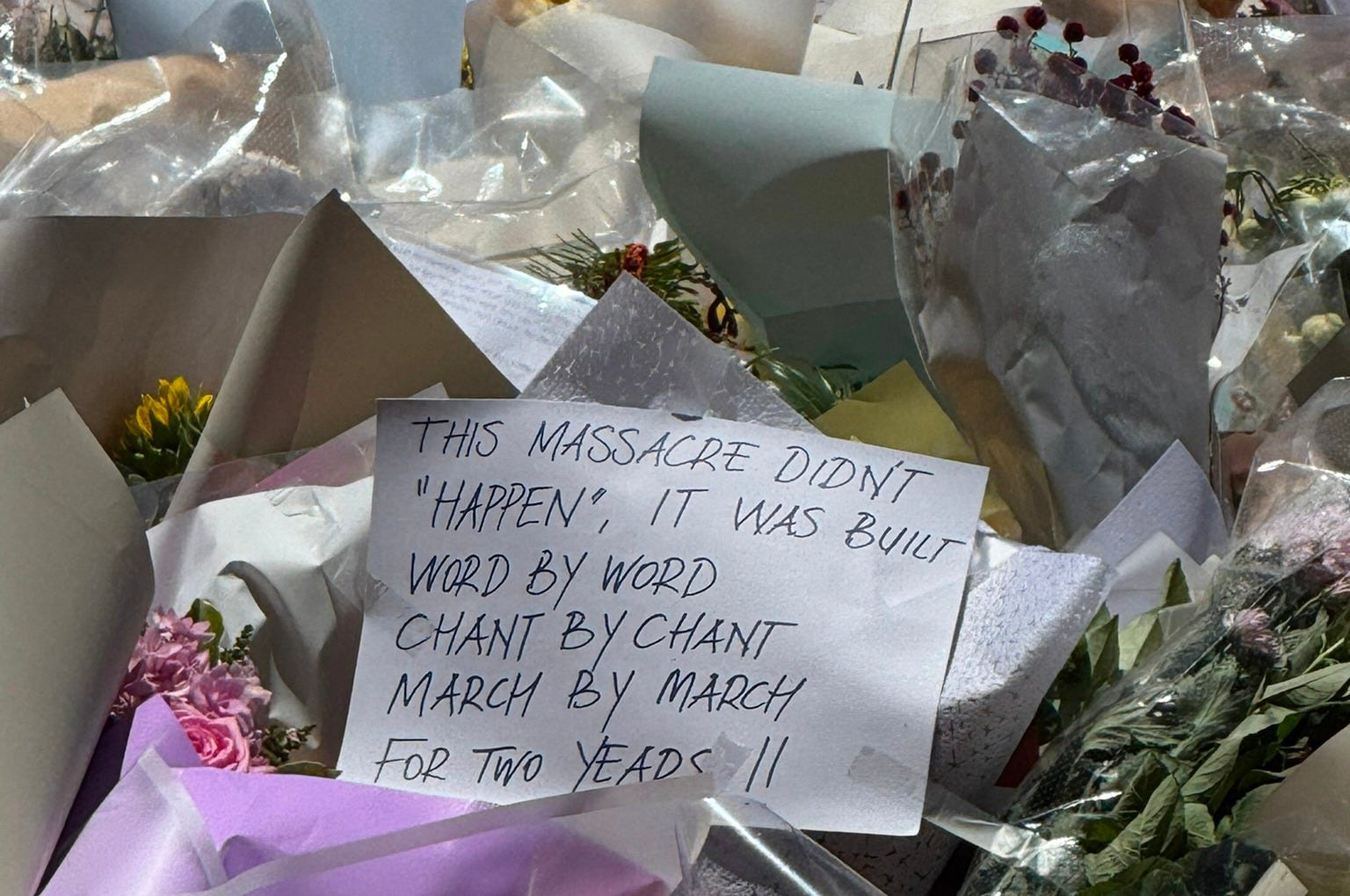
There are flowers outside our synagogue, again.
These responses matter. The tragedy of post-tragedy emotional spikes is that they do not produce turning points in and of themselves. Change is not self-propagating. Culture requires caretakers.
In Australia today, the language of antizionism has metastasised into a deadly witch hunt. It began with Jews being asked to leave their share houses, their bands, and their galleries. Jews found themselves uninvited to events, or asked to sign demeaning and violent petitions calling for the dismantling of the Jewish State on the grounds that it has been illegitimate since its 1948 conception.
Then came the smashing of businesses and MPs’ offices, the burning of synagogues, and the torching of cars. Jews requested that a definition of antisemitism be adhered to in public institutions, and a Special Envoy to Combat Antisemitism was created to make recommendations to the Federal Government.
Greens MPs, university lecturers, and public figures from every corner of the country claimed that Jews were weaponising antisemitism to stifle free speech; as though Jews had united not to protect themselves, but as a hive-mind of monsters desperate to prevent the criticism of a state we’ve been arguing about amongst ourselves for decades.
We just didn’t want those calling for a globalised intifada at weekly rallies across the nation to be able to deliver on their promise. We didn’t want the assent of that language to enable its transformation into violence. This seemed like an uncontroversial request.
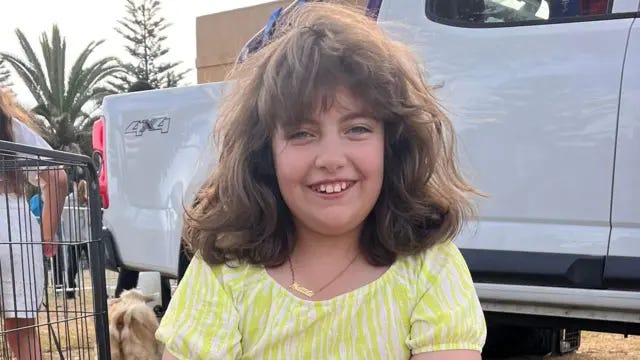
Now 15 people are dead, mowed down on the first night of Hanukkah, 2025. One of them was a little girl. Her name was Matilda—an Australian name, chosen by her Ukrainian immigrant parents as a proud and grateful acknowledgement of the life they were to build in a country far from war.
Two thousand years in two hours.
Shortly after sitting down to begin putting this into words, almost a month ago now, my partner called out from downstairs: “Candles!”
Jews commit ancient events to living memory through language. There was no Hebrew word for ‘religion’ until recently—cultural and spiritual practices coalesce, Jews bound by both more and less than religiosity on high holidays. Language constraints can make it difficult for non-Jews to understand why ‘religious’ holidays, for Jews, are not merely days of worship. For many Jews, there is no separation between the cultural and religious. These are spaces to commune as one—to inhabit the warmth of candles lit ceremonially year upon year by a people beholden to the sharing of a torch.
Hanukkah is a commitment to re-living the Jews’ victory over the Seleucid Greeks. A commemoration of triumph over conquest. It was 25 Kislev, 164 BCE, when Judah Maccabee and his followers reclaimed Jerusalem and the Second Temple from their conquerors. They discovered only one day’s worth of the oil necessary to recommence services in the desecrated temple. Somehow, the oil burned for eight days, long enough for more to be produced. Among a thousand other readings (per Rabbi), it is a story of perseverance, sacred connection, and the spreading of light as far as it will go.
Through language, Jews assume the role of custodians over their collective wisdom for the benefit of future generations. The same can be said about many other ancient peoples. In an unjust world, light is a fragile thing.
Through pogroms, conquests, and the Holocaust, Jews have commemorated Hanukkah every year on 25 Kislev. Jewish prisoners of Hamas—who were subsequently executed—lit makeshift candles in tunnels under Gaza.
Two thousand years since the Maccabean revolt, a chain stretches from ancient Jerusalem, to Bondi Beach, and into our living room in Newtown. Language is poured like liquid light from the palms of one generation to the next, warm with ancient purpose, bright as a burning bush.
On 25 Kislev 2025, Jews with outstretched hands, gathered to spread the light of Hanukkah, were mowed down by fundamentalists.
We stood in our living room and lit the Hanukkiah, our phones burning holes in our pockets. My pregnant sister had called from Bondi. My heart-rate dropped; my thoughts adjusted themselves into bullet points; my speech was whittled down to essentials. The language of survival is a language of clarity. “Candles”.
I gave a friend a lift home. He didn’t want to be seen carrying a Hanukkiah in public.
For two thousand years, Jews have been celebrating Hanukkah; history and culture preserved using the same tool used to cause so much harm: language. For two years, Jewish Australians have been under a siege created by flattened, warped, and violent rhetoric like “globalise the intifada” and “zionism is Nazism”.
Libels, when repeated, or when given institutional assent, create a terrible clarity. They enter through ears like viruses, inhabiting minds primed to absorb the language of the outraged—minds rendered defenceless to lies by the blurring of the line between propaganda and self-described social justice movements.
Antizionist libels about the irrevocable evil of the Jewish state have created a permission structure that sees everyday Australians excusing the vilification of Jews as a response to conspiratorial conceptions of Jewish national sovereignty. For many, these libels—posing as axiomata—describe immoralities that can only be amended with shared outrage; a permission structure for vilification becoming an obligation structure for participation. Language that would otherwise be considered vilification is not only allowed, but encouraged, because of conditions it creates for itself as a necessary response to evil.
Language doesn’t just allow us to describe the past, but has a material effect on the future. Antizionist language has produced a world in which a police van has been parked outside my shul for weeks; a world in which Jews are interrogated by our own security at the entry to every event from Shabbat services to book launches. A world in which a local Jewish child was spat on in the street.
Below are examples of three distinct language-based permission structures from three different epochs that have given rise to three different moral crusades against Jews.
Each permission structure is produced under different conditions and justifies itself in different ways. Each therefore requires an entirely different strategy to combat. Note: each form of anti-Jewish conspiracy is reviled for its immorality by its predecessor.
Antijudaism invented a false version of the Jewish religion using libels about its innate immorality and unfixable corruption. Libels repeated and believed positioned the Jewish religion as the moral inverse of the context’s norms—they killed Christ/they reject our God, Our God is the embodiment of goodness, ergo they are the embodiment of evil.
This created the moral permission structure necessary to call for Jews’ elimination. These libels about the Jewish religion were believed as divine fact at all levels of society, rendered true as much by hearsay as by those with their context’s dominion over truth: Popes, Caliphs, and heads of state.
Real Jews are targeted by people whose only engagement with Jews is a fantasy of their own creation. The violent response to a libellous creation of the Jewish religion is experienced by real Jews. The real Jew’s inability to stifle the libels created about his religion is a product of the invented Jews’ untrustworthiness.
Antisemitism invented a false version of
the Jewish religionthe Jewish ‘race’ using libels about its innate immorality and unfixable corruption. Libels repeated and believed positionedJudaismthe Jews as the moral inverse of the context’s norms— they are enemy aliens with dual loyalties; Jews should “go back to Palestine”, they are ethnically wrong; they’re communists and they’re working against the state by controlling the politicians and the market.This created the moral permission structure necessary to call for
the Jewish religion’sthe Jews’ elimination. These libels aboutthe Jewish religionJewish race were believed asdivinescientific fact at all levels of society, rendered true as much by hearsay as by those with their context’s dominion over truth:Popes, Caliphs,academics, scientists, heads of state.Real Jews are targeted by people whose only engagement with Jews is a fantasy of their own creation. The violent response to a libellous creation of
the Jewish religionthe Jewish race is experienced by real Jews. The real Jew’s inability to stifle the libels created about his race is a product of the invented Jews’ untrustworthiness.Antizionism invented a false version of
the Jewish ‘race’the Jewish State using libels about its innate immorality and unfixable corruption. Libels repeated and believed positionthe Jewish ‘race’the Jewish State as the moral inverse of our context’s norms—colonialism, apartheid, genocide; Jews should “go back toPalestineEurope”, they are white capitalist oppressors of the ethnically pure, indigenous Arabs; they are America’s puppet but also America’s puppet master.This created the moral permission structure necessary to call for
the Jewish race’sthe Jewish State's elimination. These libels aboutthe Jewish ‘race’the Jewish state were believed asscientifichistorical fact at all levels of society, rendered true as much by hearsay as by those with their context’s dominion over truth: academics, scientists, heads of state, algorithms.Real Jews are targeted by people whose only engagement with Jews is a fantasy of their own creation. The violent response to a libellous creation of
the Jewish racethe Jewish State is experienced by real Jews. The real Jew’s inability to stifle the libels created about his state is a product of the invented Jews’ untrustworthiness.
Antizionists are not criticising ‘Zionism’. They’re calling for the elimination of a state, with no conception of reality beyond recycled, fashionable libels.
The question is not whether language inspires, but what it inspires.
With it, one might create a phantom in another’s image before inciting a mob to hunt them down. Think Salem.
We watch crowds chant in unison, language inspiring a feeling of purpose and solidarity in response to a shared moral drive. The language of infographics goes viral, each share and each like a testament to different users’ willingness to be a productive element in a sea of clamour and catastrophe.
And despite language’s capacity to cause irrevocable harm, one should look no further than Hanukkah for evidence of its capacity to spread light.
The relationship between the Jewish people and language is a testament to its power to inspire the very opposite of the harms it has inspired against them.
With language, Jews foster cross-millennial continuity and intergenerational connection.
“Candles.”
That the hate speech-inspired Bondi Massacre could have taken place on the first night of Hanukkah is as jarring as it is profound.
We’re told that there is a ‘war on language’. Antizionists, defecting from a left-wing preference for a harm-minimisation-centred approach to language, have become the face of Australia’s free speech movement.
To the peddlers of antizionism, in all its bigotry and bile, all I have left to say is this: this is not war on language. This is a war on you.
Do you know what we did on the second night of Hanukkah this year? We lit two candles.
You cannot win.
How We Will Win.
If Australians are serious about protecting Jews, we must examine the language being used and the future it’s producing. We do this all the time. In contracts, marriage vows, and law, we accept that words structure expectations and consequences. We understand that language does not merely describe reality; it helps create it—from thousands of years of lighting candles to promising to return a rental car.
Over the past two years, language created an environment in which demonisation was excused as political expression because it didn’t fit the post-Holocaust race-based definitions of Jewish vilification designed to protect Jews from antisemitism.
Due to the institutional consolidation of antizionist libels, questioning the vilification of ‘Zionists’ has been considered more objectionable than the antizionist campaign itself. It would be easy to attribute the ease with which libels like ‘genocide’ and ‘apartheid’ have been superimposed onto the Gaza war by blaming the advent of Qatari state media enterprise Al-Jazeera’s, and other well-oiled misinformation machines.
The truth, however, is that tens of thousands of Gazan civilians are dead. Libels sit like sleeper agents, waiting to be activated by anything close to, or even describing itself as, a grain of truth. There is no escaping the fact that the horrifying death toll has re-invigorated the antizionist movement. Just as there is no escaping the fact that to blame this war for the advent of an eliminationist movement that not only pre-dates it by half a century, but caused it, is as absurd as it is an insult to the dead.
And the dead are far-reaching. Not because of the war in Gaza, but because antizionist hate insists itself upon the lives on Jews wherever they live.
How we describe the Bondi massacre and the movement that incubated it will shape not only the safety of Australian Jews but the future of Australian society.
Conspiracies and Crucifixion.
The word antizionist has been allowed to occupy a space of moral loft, some mistaking antizionism as the criticism of Israeli policy, and others considering it simply less immoral than those it stalks.
Criticism of Israel, however inflammatory or adversarial, is not by its nature antisemitic or antizionist. How could it be? Jews spend more time criticising Israel than non-Jews, just as Australians are more critical of our own country. When we care about something—when we want it to be the best version of itself—we are critical.
Many antizionists continue to recycle classical antisemitic libels, conspiracies, and propaganda. For example, not long after October 7, Greens MP Jenny Leong publicly stated that “the Jewish lobby and the Zionist lobby are infiltrating … their tentacles reach into the areas that try and influence power. We need to call that out and expose it.” This is the vernacular that underpins the Boycott, Divestment, Sanctions (BDS) movement—which Clover Moore’s City of Sydney Council has now adopted. Clover Moore’s tears at the Bondi Pavilion cannot undo the damage caused by antizionism.
Let us be clear: antizionism is a commitment to eliminating, not improving, the Jewish state. When my parents criticised my homework, it was because they were invested in my longevity.
Antizionist organisations like the Australia Palestine Advocacy Network (APAN) and the Palestine Action Group (PAG) are to the Jewish state what Nazis were to the Jewish people. Eliminationists. It is not criticism that Jews want stifled. It’s bigotry.
Both the antisemite and the antizionist design their enemy as a nefarious abstraction in need of moral confrontation, which compels the public to confuse libel with critique. Neither engage with their professed counterpart, instead fighting against warped constructions of their own making.
To many Westerners, antizionism functions as both a moral purity test and a vehicle for atonement. By constructing the Zionist as impure, the antizionist’s crusade becomes an omnicausal, hyper-generalised, and cartoonish battle between good and evil. The campaign for the elimination of the Jewish state represents the tip of the spear of an omnicausal battle against all forms of oppression—all of which the Western antizionist seeks absolution for by tilting at a Jewish windmill.
Antizionism dumps the totality of humanity’s sins into a basket named Zionism, mirroring the symbolic sacrifice of the world’s most famous Jew—Jesus Christ—for the absolution of mankind. Zionism’s real name is Israel/Yisra’el (ישראל). Jesus’s real name was Joshua (Yeshua) (ישוע).
This is why so many disconnected social justice causes are able to so neatly adopt antizionism. Zionism becomes synonymous with capitalism, nationalism, white supremacy, ecocide, absorbing all the world’s evils, its crucifixion promising to deliver humanity from its sins.
Antizionism’s capacity to absorb disparate moral crusades functions like all conspiracy theories. Everything one resents can be explained by the same evil connective tissue—whether it’s the Jewish ‘race’ one century, or their right to self-determination the next. This week Zionists were blamed for the United States’ capture of Venezuelan President Nicolas Maduro.
The difference between antisemitism and antizionism is not one of reasonableness, but of institutional assent. The similarity is that both weaponise language to harm Jews.
Antizionists in the past two years have burned down synagogues on five continents, killed Jews in Washington, Colorado, and Manchester, raped Jews in Paris, and assaulted Jewish children in Sydney. Antizionism saw over a million Jews displaced across the Middle East in the mid-20th century. Thirteen thousand Polish Jews were exiled in the 1968 antizionist purge. In Munich, 1972, Jews were murdered and their bodies mutilated. Hundreds were blown up in Argentina’s AMIA bombings in 1994.
October 7 was carried out by antizionists, as was the Bondi massacre.
What more evidence could one possibly need that the education and regulation of the language of antizionism is crucial?
Many antizionists in the West who celebrated or justified the murder, rape, and hostage-taking of Israelis insist they oppose antisemitism. Some of these people continue to lecture at our universities, receive government grants for their art, and occupy public office. Will a Royal Commission into antisemitism have any effect on these people’s hate speech? By using ‘antisemitism’, or race-based vilification, as the test for anti-Jewish bigotry, will antizionism go untouched?
Candles, again.
Australians must recognise language as humanity’s most powerful tool, capable of inspiring both the sublime and the foul.
To confront this foulness, Australians can look to our Jews for more than inspiration: look to us for courage. We can learn as much from the creation and preservation of Hanukkah as we can from the Hanukkah massacre.
Australia: look to the thousands of years of evidence of what language can do. Look to our thousands of years of what language has done.
A people whose culture survived exile and extermination were driven to light candles on a beach on 25 Kislev by the language of their forefathers, who 2,000 years ago on 25 Kislev witnessed a miracle and wrote it into memory. They were gunned down, first by the language of their contemporaries, and then by the violence it encouraged.
Whether it spreads light or brings darkness, language is one of the few things humanity has control over.
We cannot change what’s happened. We will change what happens next.
You’ve so beautifully expressed the real struggle and explained what I felt was going on, the loopholes, the inaction of authorities. Thank you.
I’m probably naive but I have always had the sense that anti-Semitic and anti-Zionist really boil down to the same thing.
I read it out aloud.
Huge.