

Puppets
Performance Management For Normal People

Yesterday one of my partner’s colleagues, a PR specialist, made a passing comment about the rise of the social media advocacy in the wake of tragedy.
I’d just completed training members from a few of Australia’s most significant Jewish organisations, and had taken a moment after an extra hour spent in further conversation with participants.
She and I drank coffee as we discussed the viability of rolling out the Movement Against Antizionism’s resources to communities of all backgrounds.
Much of my work at the moment is public. Whether it’s live talks, on social media, or in national publications, I have partitioned myself into pieces that I can trust the world with, and pieces that I can’t.
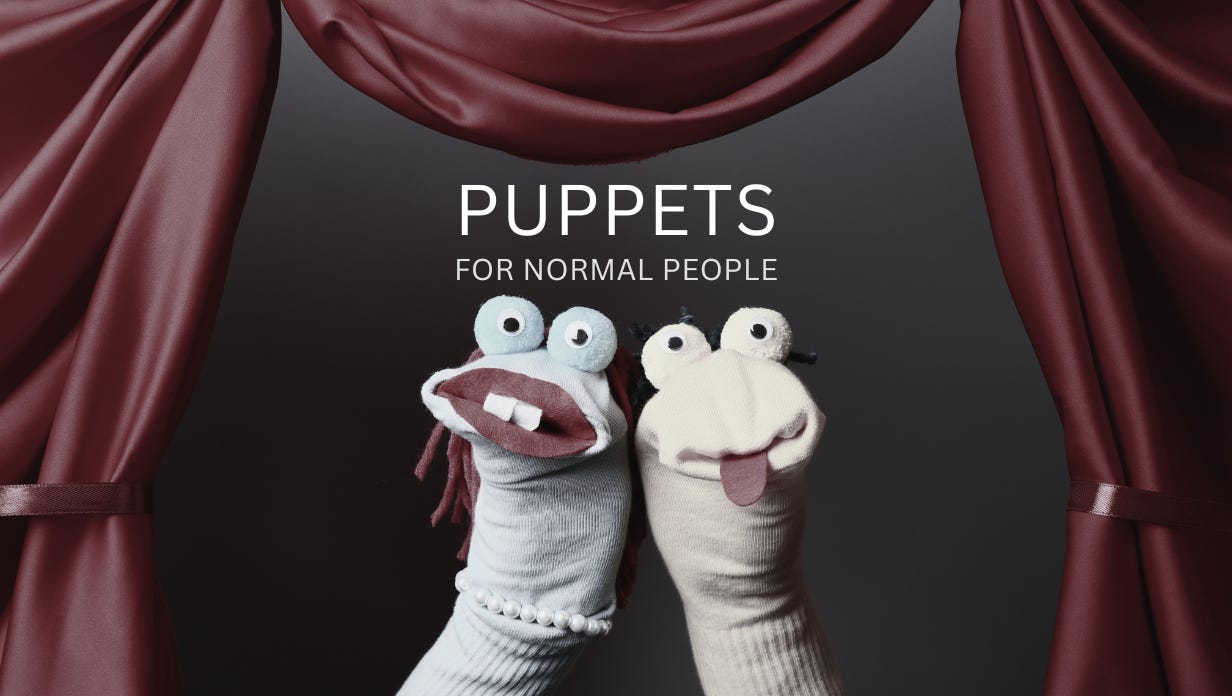
The "Joshua Dabelstein” presenting on matters pertaining to bigotry, hate, identity, and culture is a puppet controlled, mostly, by a real human called Joshua Dabelstein.
Real Human Joshua Dabelstein pulls the Puppet Joshua Dabelstein’s strings in the hope that a balance can be struck that secures the reliable transferring of information against the unreliable, fallible entity hidden behind run-on sentences and spit-shined RM Williams boots.
If there was a way I could do this work without sharing my name or my face, I’d do it. We use AI to create work designed to sound as much like ourselves as possible, passing off the labour carried out by robots as ours. Often, to some significant extent, it is.
We slap our names on a perfectly formatted report rife with AI-tells like, “but that isn’t neutral”, “this collapses into that”, and, “it’s not X, but Y”, convinced that the work produced is a better reflection of our aptitude than what we may be able to produce without the help of these machines.
Having spent some time working for an AI startup, as a writer, as Head of Communications at The Online Hate Prevention Institute, and as Non-Fiction Editor at Verity La, I can say from experience that the lengths many go to to convince our audiences that our Puppet Selves are legitimate representations of our Real Selves is remarkable.
It is also something that—for myself—I’m desperately keen to avoid. I would much rather that the version of myself that is known to the world through my work be considered anything but an effort to convey Real Human Joshua Dabelstein.
Dramaturgical analysis, developed by sociologist Erving Goffman, compares everyday social interaction to a theatrical performance. Goffman saw social situations as a stage where individuals “perform” different roles associated with their identities.
I was struck by the phrase ‘impression management’ as I poured over Goffman’s landmark 1959 work, The Presentation of Self in Everyday Life.
Goffman’s analysis separates our interactions into a “front stage” and a “back stage.” The front stage is the public version of ourselves that we show to others, while the back stage is where we can relax, drop the performance, and behave more naturally. The theory focuses on how people manage impressions through their behaviour, appearance, and communication, often shaping how others understand us.
The interesting thing about how we curate our ‘public image’ is that we do it without fully realising we’re doing it. It is in part a reflex. Reflexes don’t require conscious intervention.
This means that the show we put on for others is being written within recesses of our brains that we aren’t in conversation with. We may believe ourselves to be saying or doing things for reasons that we understand, but are often catering to deeper needs that we may have not investigated.
For example, I may believe that I have become involved in fighting antizionism for all of the obvious reasons. But there are parts of me shaped since the day I was born that are now interacting with the present in hidden ways. This may be as much about doing the right thing as it may be the manifestation of an injustice complex forged within the confines of a family dynamic.
Perhaps the most honest appraisal of the partitioning of myself is to lean into some combination of Goffman and armchair psychoanalysis, begging the question: who is really pulling the strings here?
Is Real Human Joshua Dabelstein as much of a construct as the puppet? Could the puppet be a manifestation of deeper, more honest pieces of myself than I realise?
Is writing and talking and publicly engaging with the world’s troubles accidentally sharing more of who I am than Real Joshua Dabelstein was ever ready to admit? Is my work as much a manifestation of the very kinds of complexes that it purports to expose?
It’s late, and I should go to bed. But I just wanted to get some of these things down before they fall into the crevice where all other half-explored questions go.
The more of myself that I spatter, the more I fear that I may be misrepresented and maligned by those who consider my work threatening.
The Puppet Self was supposed to be a shield, but in this late and lonely hour, I cannot help but wonder just how much more he says about me that I couldn’t if I tried.
Please consider upgrading to a paid subscription here. It make a huge difference. Likes and comments really help as well, and sharing is the best way to help For Normal People grow.
Melbourne event dates:
June 18: Book here
June 22: Book here [preferred - 200 seats, city location]
June 23: Book here

From my puppet to yours❤️
Interesting and introspective. Funny, I have a copy of Goffman's "Presentation of Self" and was just looking for it before reading your post.